

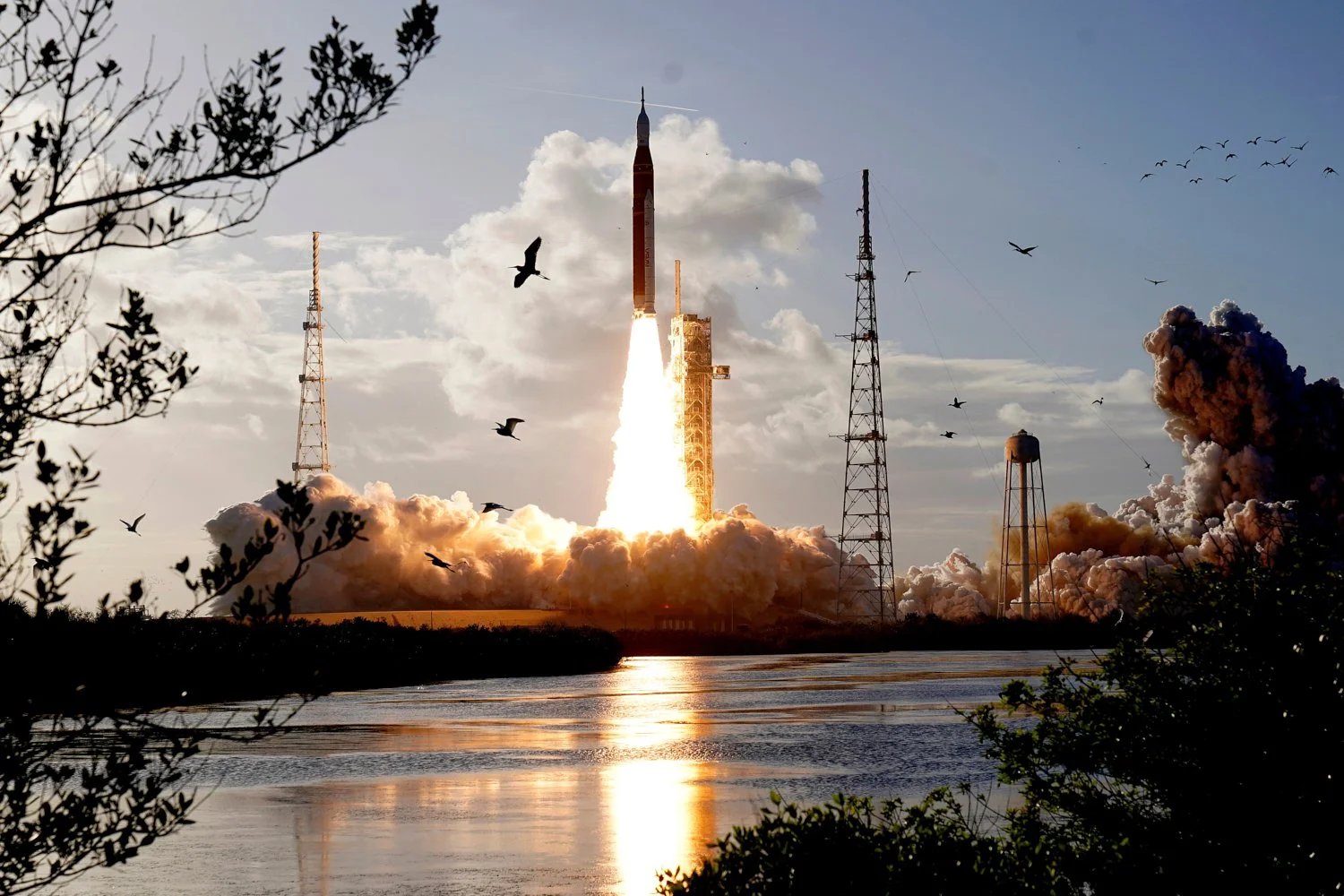
While the world watches AI and obsesses over chatbots, the most consequential geopolitical competition of the decade is happening 240,000 miles overhead. The Artemis program, humanity's return to the moon, isn't just about science or prestige. It's about establishing the legal, economic, and military framework for everything that happens in space for the next hundred years.
And it's closer than you think.
What's actually happening
Artemis isn't a single mission. It's a sustained campaign: crewed lunar landings, a permanent base at the south pole, a space station in lunar orbit, and eventually a launchpad for Mars. The south pole matters because of water ice, trapped in permanently shadowed craters, it's drinking water, breathable oxygen, and rocket fuel, all in one.
Whoever controls the best lunar real estate controls the logistics hub for the entire inner solar system. That's not hyperbole. The moon's low gravity makes it the ideal staging ground for missions to Mars, asteroid mining operations, and deep-space telescopes.
Whoever controls the best lunar real estate controls the logistics hub for the entire inner solar system.
The other team
Enjoying this story?
Get the five most important stories in tech, every morning. Free.
This isn't a solo effort. China and Russia have their own lunar program targeting the same south pole region, on a similar timeline. The competition is real, and the stakes go beyond bragging rights.
The 1967 Outer Space Treaty says no nation can claim sovereignty over celestial bodies. But it says nothing about resource extraction, and the Artemis Accords, signed by 30+ nations, attempt to fill that gap with principles for mining, safety zones, and scientific cooperation. China hasn't signed. The result is two competing frameworks for who gets to do what on the moon.
Why it matters now
Space law is being written in real time, through actions rather than treaties. Every landing site chosen, every resource extracted, every "safety zone" declared sets a precedent. The nations and companies establishing facts on the lunar surface today are writing the rules everyone else will follow tomorrow.
The commercial dimension is equally significant. Lunar mining, space manufacturing, and orbital infrastructure represent a potential multi-trillion-dollar economy. The companies positioning themselves now, for water extraction, habitat construction, communications relay, are placing bets on the largest new market in human history.
We went to the moon in 1969 to prove we could. We're going back to stay. The question isn't whether humanity becomes a multi-planetary species: it's who leads, who profits, and who decides.
36 Comments