
Quantum computing has been "five years away" for about twenty years. So skepticism is warranted whenever a milestone is announced. But something shifted recently: not a press-release breakthrough, but a quiet, peer-reviewed threshold that changes the practical calculus. Here's what happened and why it matters.
What actually happened
The milestone is about error correction overhead, the central obstacle in quantum computing. Quantum bits are exquisitely fragile; they decohere in microseconds, corrupted by the slightest environmental noise. To do useful computation, you need logical qubits: error-corrected abstractions built from many physical qubits.
The ratio matters enormously. Early estimates suggested you might need a thousand physical qubits per logical qubit, a ratio that pushes practical machines decades out. Recent results have driven that overhead down dramatically through better codes and better hardware, crossing below a threshold where the scaling math starts to look feasible rather than fantastical.
The question changed from "is this possible in principle?" to "how fast can we engineer it?" That's a phase change.
Why error correction is everything
Enjoying this story?
Get the five most important stories in tech, every morning. Free.
To understand the significance, consider what quantum computers are actually for. They won't replace your laptop. They're suited to specific problem classes: simulating quantum systems (drug discovery, materials science), certain optimization problems, and, famously, breaking current encryption via Shor's algorithm.
All of these require deep circuits: long sequences of quantum operations. Without error correction, noise accumulates and the computation produces garbage after a few dozen steps. Error correction is what turns a physics experiment into a computer. Every improvement in the overhead ratio shortens the timeline to usefulness.
What it doesn't mean
Let's be clear about what hasn't happened. Nobody has a fault-tolerant quantum computer sitting in a data center. The machines that exist are still in the tens-to-hundreds of physical qubits range, and the road to thousands of logical qubits remains an engineering marathon.
It also doesn't mean encryption is broken tomorrow. The oft-cited threat to RSA and elliptic-curve cryptography requires millions of physical qubits running for hours. We're closer than we were, but "closer" on a logarithmic scale still leaves room to prepare, and the migration to post-quantum cryptography is already underway.
Why the timeline changed
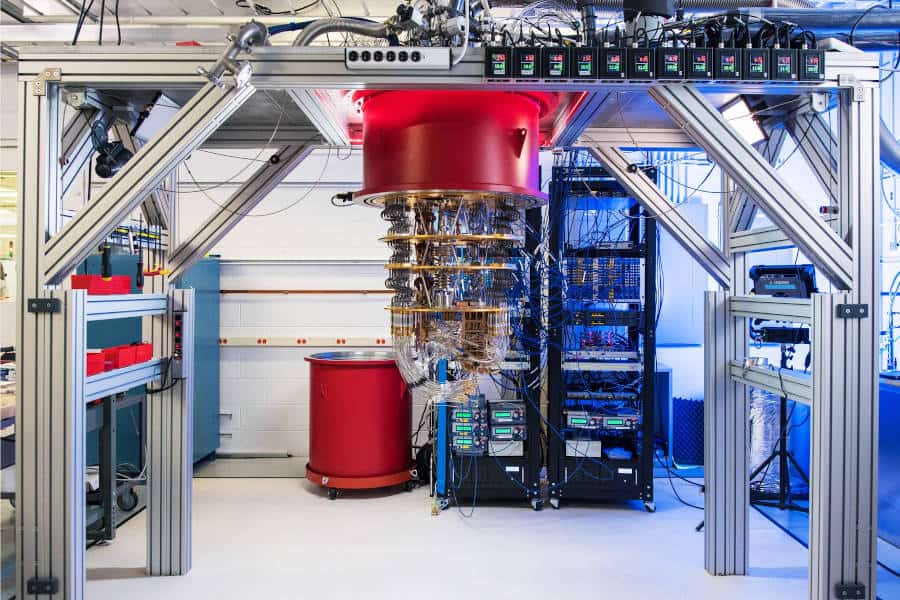
The important shift isn't a single result. It's the rate of improvement. Error rates are falling, coherence times are rising, and error-correcting codes are getting more efficient, simultaneously. When multiple exponential trends compound, timelines compress in ways that linear intuition misses.
The researchers we spoke to describe a mood change in the field: from "can this ever work?" to "how fast can we scale it?" That's not hype. It's what happens when the fundamental physics questions get answered and the remaining problems become engineering problems. Engineering problems get solved on schedules.
When multiple exponential trends compound, timelines compress in ways that linear intuition misses.
What to watch
Three things will signal the next phase. First, logical qubit demonstrations that maintain coherence longer than their physical constituents, proof that error correction is net-positive. Second, useful quantum simulation of a molecule or material that's intractable classically, the first real-world win. Third, manufacturing scale: moving from hand-built lab devices to fabricated chips.
Quantum computing may still surprise us, in either direction. But the era of dismissing it as perpetual vaporware is ending. The physics works. Now it's an engineering race, and engineering races have winners.
The software stack problem
Hardware gets the headlines, but quantum computing's quiet crisis is software. Writing quantum algorithms requires thinking in superposition and entanglement, a cognitive leap most developers will never make. The field needs its equivalent of the C compiler: abstractions that let ordinary programmers use quantum resources without understanding the physics.
Progress is happening. High-level quantum SDKs now let developers express problems in familiar terms, optimization objectives, molecular structures, while the framework handles circuit construction. But the tooling is roughly where classical computing was in the 1960s: powerful in principle, painful in practice.
This is actually good news for the timeline. Software tooling historically lags hardware by years, then catches up suddenly when the economic incentive appears. The moment a quantum computer does something commercially valuable, the tooling investment will flood in. The physics milestone we just crossed is what starts that clock.
6 Comments