
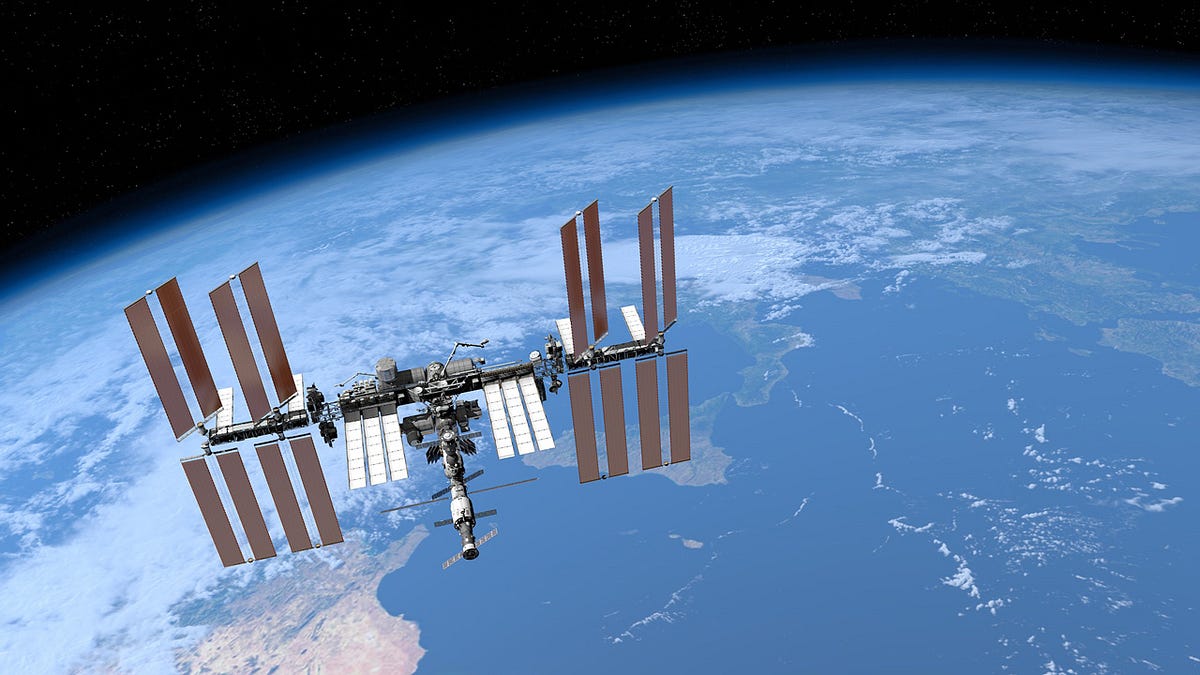
On October 13 at 6:33 AM Eastern, a SpaceX Falcon 9 rocket will lift off from Florida carrying the CRS-35 cargo Dragon toward the International Space Station. Bolted to its unpressurized trunk: the final set of ISS Roll-Out Solar Arrays, the last major hardware upgrade the station will ever receive.
It is a poignant milestone. The ISS, continuously occupied for more than a quarter century, is in its final chapter, with a controlled deorbit planned for around 2030. This last power upgrade is about making the station's remaining years its most productive.
The final power boost
The roll-out arrays unfurl like window shades over the station's original, degraded arrays, boosting total power output by a significant margin. The station's first-generation arrays have spent decades in the harshest environment imaginable: unfiltered solar radiation, micrometeorite strikes, and wild thermal swings. Their output has faded with age.
The new arrays ensure the ISS has the electricity its packed final science manifest demands. Every experiment, every life-support system, every communications downlink runs on power. For a station entering its most research-intensive years, this upgrade is the difference between coasting and sprinting to the finish.
Science in the cargo hold
Enjoying this story?
Get the five most important stories in tech, every morning. Free.
Alongside the arrays, CRS-35 carries a striking research lineup. There is hardware for an artificial retina, technology that could one day restore vision to the blind. There are 3D models of human heart tissue, for studying cardiac disease in an environment where cells grow in three dimensions, free from the flattening distortions of gravity. And there are brain organoids, miniature lab-grown brain structures, for Alzheimer's and Parkinson's research.
Microgravity is a laboratory that cannot be replicated on Earth. Proteins crystallize more perfectly, tissues grow more naturally, and fluids behave in ways that reveal new physics. The ISS has become one of the most productive research facilities in history, and its final missions are loaded accordingly.
Why eyes, hearts, and brains
CRS-35: Mission at a Glance
The last major hardware upgrade the ISS will ever receive.
Note: For illustrative purposes only.
The three headline experiments share a common thread: they all exploit the way biology behaves when gravity stops interfering. The artificial retina hardware tests components designed to convert light into electrical signals the optic nerve can interpret, a stepping stone toward implants for degenerative blindness. Researchers want to know how the delicate electronics and biological interfaces behave during long orbital exposure.
The 3D heart tissue models address a stubborn problem in cardiology. On Earth, lab-grown heart cells flatten under their own weight, distorting how they beat and respond to drugs. In microgravity, they assemble into more lifelike structures, giving scientists a truer model for testing treatments. Previous ISS experiments have already shown that heart tissue matured in orbit behaves more like adult human heart muscle than anything grown on the ground.
The brain organoids push furthest into the unknown. These lentil-sized clusters of human neurons develop layered structures resembling early brain tissue. In orbit, researchers can watch how microgravity affects their growth and electrical activity, insights that feed into Alzheimer's and Parkinson's research, where the misbehavior of neural networks is the disease itself. If the station's final years produce a breakthrough in neurodegeneration, it may well trace back to cargo like this.
The station's final years may be its most scientifically productive, if it has the power to run the experiments.
A $946 million vote of confidence
In parallel with the cargo flight, SpaceX locked in a $946 million NASA deal for three additional crew rotation flights. The message is unambiguous: NASA is doubling down on the commercial crew model even as it plans the station's retirement.
The deal extends a partnership that has fundamentally changed human spaceflight. Where astronauts once flew exclusively on government vehicles, they now ride commercial capsules as a matter of routine, the 20th SpaceX human spaceflight splashed down just days ago.
Counting down to 2030
After the arrays are installed, the station's hardware story is essentially complete. What remains is science, and the handoff. Commercial space stations are under development to take over in low Earth orbit, and NASA's attention is shifting toward the moon.
The ISS will end with a controlled deorbit into a remote stretch of the Pacific. Until then, every mission like CRS-35 squeezes more discovery from humanity's greatest orbital outpost. The last upgrade is not an ending. It is a final push.
176 Comments