
Every second, 100 trillion neutrinos pass through your body. They stream from the sun, from supernovae, from black holes devouring stars at the edge of the observable universe. They pass through everything, you, the Earth, entire galaxies, as if none of it were there. For most of human history they were undetectable in principle. Then Francis Halzen had an idea so audacious it sounded like a joke: turn a cubic kilometer of Antarctic ice into a telescope.
This week, that idea won the Nobel Prize in Physics. On October 6, the Royal Swedish Academy of Sciences awarded Halzen the prize for the IceCube Neutrino Observatory, a detector buried in South Pole ice that opened an entirely new window on the universe. It is the culmination of a vision he pursued for decades, through skepticism, funding battles, and the small logistical challenge of building anything at the bottom of the world.
The ghost particle
Neutrinos are the most abundant massive particles in the universe and the hardest to catch. They interact so weakly with matter that a light-year of lead would barely slow them down. The sun produces them in staggering numbers through nuclear fusion. More exotic sources, supernovae, gamma-ray bursts, supermassive black holes, accelerate them to energies millions of times beyond anything human accelerators can produce.
Those high-energy neutrinos are cosmic messengers. They travel in straight lines from the most violent events in the universe, unbent by magnetic fields, unabsorbed by dust. If you can catch them, they tell you exactly where they came from. The problem was always the catching.
A light-year of lead would barely slow a neutrino down. Halzen decided to catch them anyway.
A telescope made of ice
Enjoying this story?
Get the five most important stories in tech, every morning. Free.
Halzen's insight was that you do not need to build a detector. Nature already built one. When a high-energy neutrino very occasionally collides with an atomic nucleus in ice, it produces a flash of blue light called Cherenkov radiation, plus a shower of secondary particles. Instrument a large enough volume of transparent ice with light sensors, and you can catch those flashes and reconstruct the neutrino's direction and energy.
The Antarctic ice sheet, two kilometers thick, crystal clear, and utterly dark, turned out to be the perfect medium. Starting in the 2000s, Halzen's team drilled 86 holes deep into the ice, lowered strings of basketball-sized optical sensors into each one, and let the ice refreeze around them. The result was IceCube: 5,160 sensors watching a cubic kilometer of ice, the largest scientific instrument ever built.
What the ice saw
IceCube: From Crazy Idea to Nobel Prize
Four decades of turning Antarctic ice into a telescope.
Note: For illustrative purposes only.
The gamble paid off. In 2013, IceCube detected the first high-energy neutrinos from beyond our galaxy. In 2017, it traced a neutrino back to a flaring blazar, a supermassive black hole four billion light-years away, the first time humanity had identified the source of a cosmic neutrino. In 2022, IceCube found neutrinos streaming from the heart of our own galaxy.
Each detection was a first. Neutrinos became the newest cosmic messenger since gravitational waves, a new way of seeing the universe's most extreme events.
Why it matters
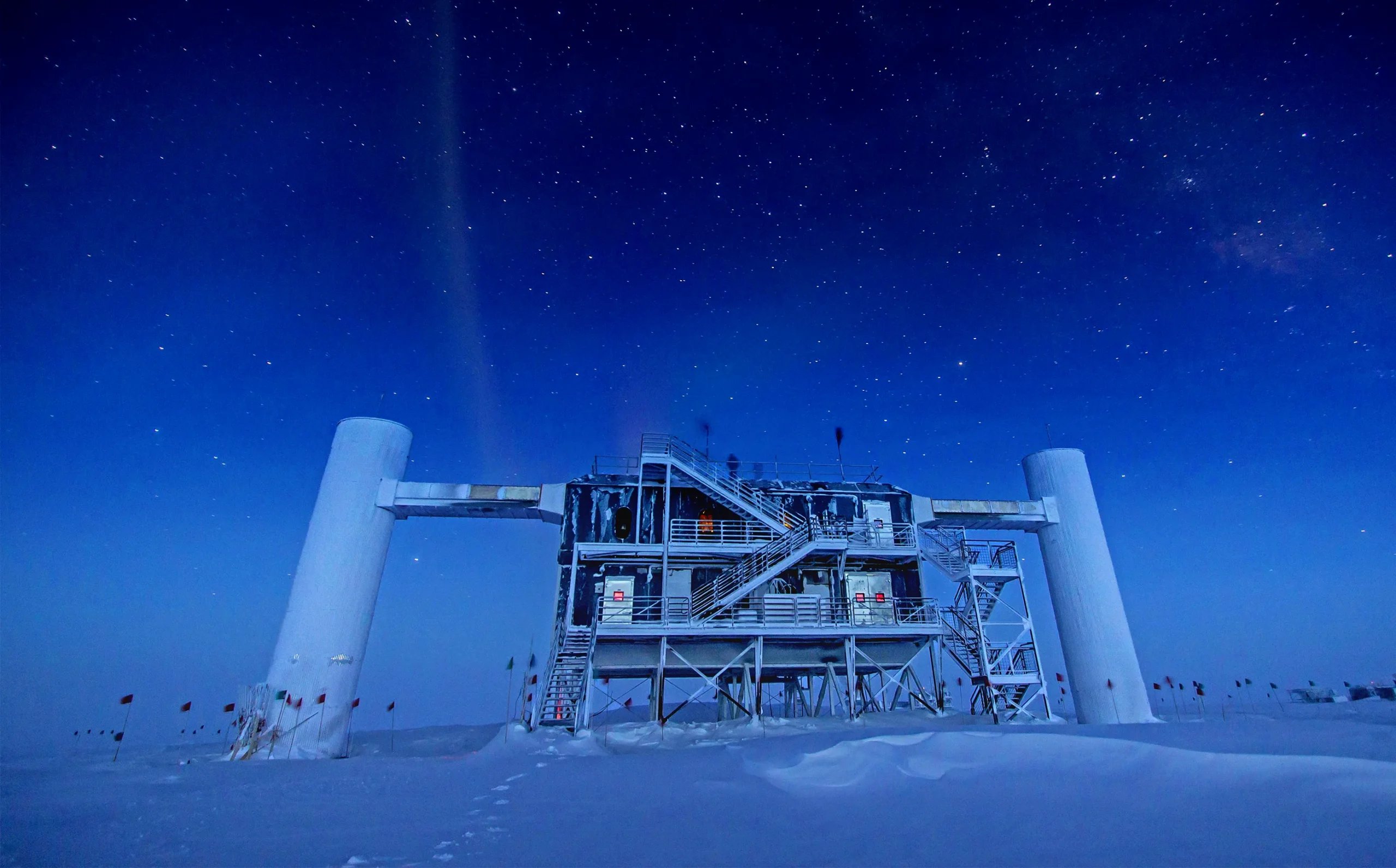
Neutrino astronomy is still in its infancy, roughly where optical astronomy was when Galileo first pointed a telescope at Jupiter. But the trajectory is clear. IceCube's successor, IceCube-Gen2, will be ten times larger. Similar detectors are rising in the Mediterranean Sea and a Siberian lake. Together they are building a planet-scale observatory for the universe's most elusive particles.
Halzen, now in his eighties, spent decades being told his idea would not work. The Nobel recognizes not just a discovery but a particular kind of scientific courage: the willingness to bet a career on an idea everyone else thought was crazy, then spend twenty years proving them wrong.
180 Comments