
Quantum computing has been "five years away" for roughly thirty years. The joke wore thin a decade ago. But something shifted this year that even the skeptics are acknowledging: quantum computers started doing useful work, the kind companies pay for, on problems that matter.
The milestone isn't a single breakthrough. It's a threshold crossed quietly, in drug discovery labs and battery research groups, where quantum workflows beat classical ones on real molecular problems often enough that the accountants noticed.
The problem quantum was built for
Here's the thing most coverage misses: quantum computers were never going to be faster laptops. They're specialists. Simulating molecules is their native task, because molecules are quantum systems, and simulating a quantum system on a classical computer requires exponential effort as the molecule grows. A quantum computer sidesteps that wall entirely.
That specificity is why the "useful" moment arrived in chemistry first. Drug companies need to predict how candidate molecules behave: binding affinity, toxicity, stability. Classical approximations work for small molecules and fail for interesting ones. Quantum simulation fills exactly that gap.
Quantum computers were never going to be faster laptops. They're specialists, and chemistry is their native task.
What actually changed
Enjoying this story?
Get the five most important stories in tech, every morning. Free.
Three things converged. First, error correction matured. Quantum bits are fragile; the information they carry decays in microseconds. The field spent a decade learning to spread one logical qubit across many physical ones so errors can be detected and fixed. That technique crossed the breakeven point a couple of years ago and has been compounding since.
Second, hybrid workflows got good. Nobody runs a whole drug pipeline on a quantum chip. The winning pattern splits the problem: classical computers handle what they're good at, quantum processors handle the hard quantum subproblems, and clever software stitches the answers together. It's unglamorous and extremely effective.
Third, access got easy. You no longer need a physics PhD and a dilution refrigerator. Cloud quantum services now offer the relevant workflows through APIs that a computational chemist can use without knowing what a transmon is. Abstraction did for quantum what it did for every computing revolution before it.
Who's using it
Quantum Computing: The Road to Useful
Key thresholds on the path from lab curiosity to industrial tool.
Note: For illustrative purposes only.
Pharmaceutical companies are the furthest along, using quantum-assisted simulation to screen molecular candidates before expensive lab synthesis. Battery researchers are modeling electrolyte chemistry that classical methods approximate poorly. A handful of materials startups are designing catalysts, including one targeting ammonia production, a process that consumes roughly 2% of global energy.
The honest caveat: these are narrow wins. Quantum computers still can't factor the large numbers that would break encryption (and the timeline for that keeps slipping). They won't speed up your spreadsheet. The "useful" in question is useful for specific, high-value scientific problems, not general computing.
Why this time is different
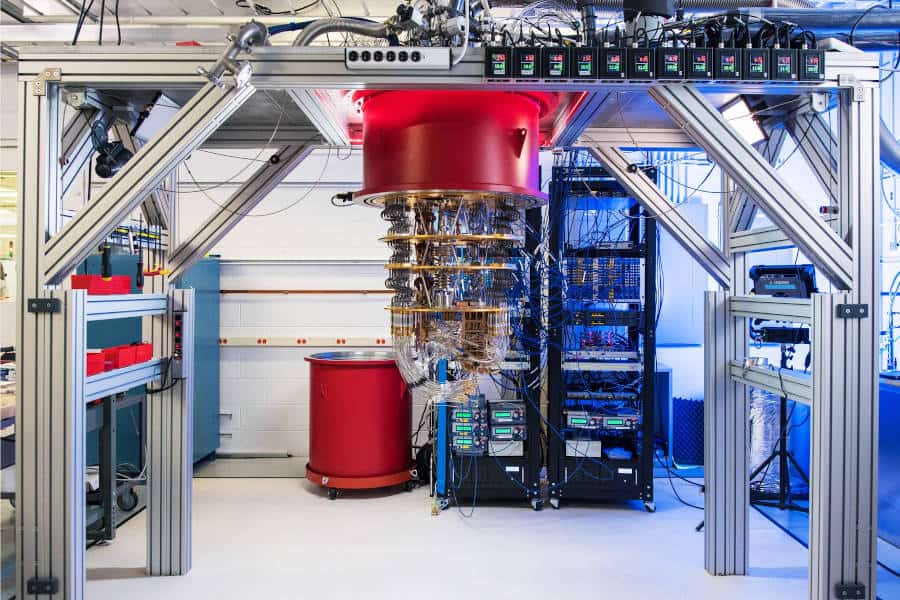
Every previous quantum hype cycle was driven by physics milestones: more qubits, longer coherence, fancier demonstrations. This cycle is driven by customer behavior. Companies are renewing contracts. Research groups are publishing results obtained on quantum hardware, not just about quantum hardware. Revenue, however modest, is flowing from users to providers for completed work.
That's the difference between a science project and a technology. Science projects produce papers. Technologies produce invoices. Quantum computing just started producing invoices.
The road ahead is still long. Fault-tolerant machines with millions of physical qubits remain a decade-scale engineering project. But the field has crossed the most important threshold of all: from "someday" to "today, for these problems, it's already worth it."
The talent bottleneck
Ironically, the scarcest resource in quantum computing isn't qubits. It's people. The field needs a strange hybrid skill set: quantum physics, software engineering, and domain expertise in chemistry or materials science. Universities produce a few hundred such graduates a year globally. Industry demand is multiples of that.
Companies are responding by building abstraction layers that let domain experts use quantum tools without quantum training, the same way cloud computing let developers deploy servers without studying networking. The most successful quantum software firms now describe themselves as chemistry companies that happen to use quantum hardware, a telling shift in identity.
What the skeptics still say
The serious skeptics haven't disappeared; they've refined their objections. Their case: the current wins are real but narrow, the error-correction overhead remains brutal (thousands of physical qubits per logical one), and the economic advantage over ever-improving classical methods (including AI-accelerated simulation) is thinner than the hype suggests.
There's merit in the caution. Classical computing isn't standing still, and machine-learning approaches to molecular simulation have improved dramatically, eating into quantum's advantage from the other side. The race isn't quantum versus nothing. It's quantum versus the best classical methods, with AI now supercharging the classical side.
But even the skeptics concede the direction of travel. The question has shifted from "will quantum computers ever be useful?" to "how broad will the useful domain become, and how fast?" That's a very different conversation, and it's the one the industry is now having with its customers' money.
143 Comments